
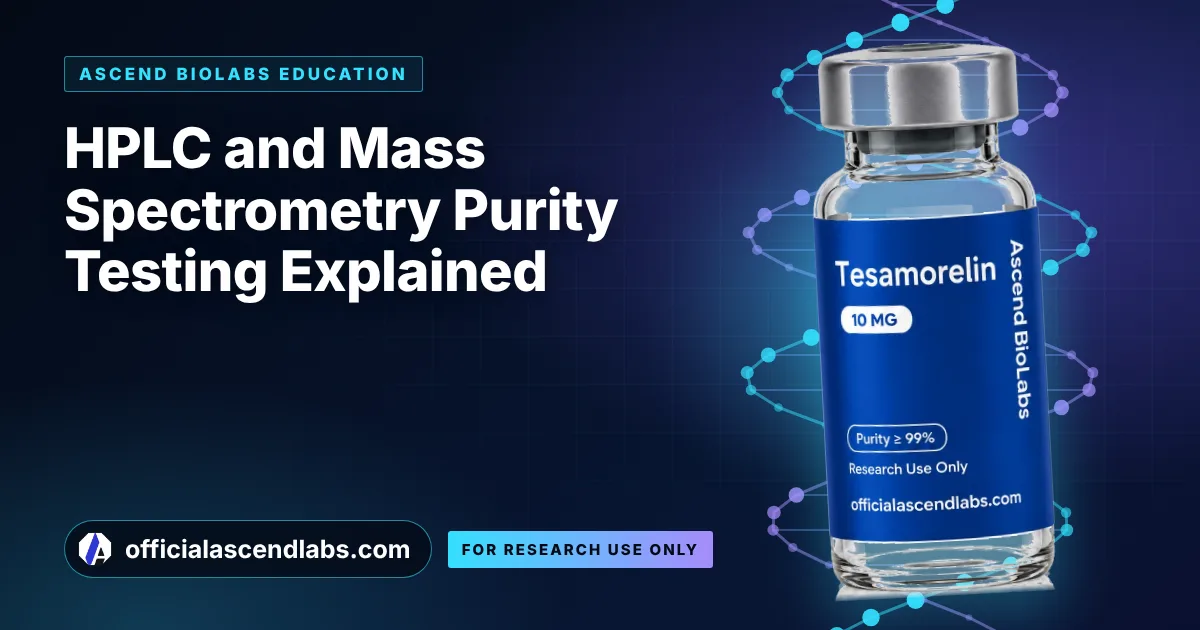
HPLC and Mass Spectrometry Purity Testing Explained
All Ascend Bio Labs products are sold strictly for in vitro and laboratory research by qualified adults. They are not drugs, foods, cosmetics or supplements, are not for human or veterinary use, and have not been evaluated by the FDA.
Two techniques sit behind almost every peptide certificate of analysis: high-performance liquid chromatography (HPLC) and mass spectrometry (MS). They answer different questions, and understanding both makes the numbers on a COA much easier to trust.
HPLC: how pure is the sample?
In HPLC a small amount of dissolved sample is pushed under high pressure through a column packed with fine particles. Different molecules travel through at different speeds, so the sample separates into its components. A detector at the end, usually measuring ultraviolet light at about 214 nm where the peptide bond absorbs, draws a trace called a chromatogram: a series of peaks, one per component.
The tallest peak should be the target peptide. Purity is the area of that peak divided by the total area of all peaks, expressed as a percentage. If the main peak accounts for 99.5% of the total area, the report says 99.5% purity. The smaller peaks are impurities such as truncated sequences, deletion products or leftover protecting groups.
What 99% does and does not mean
A 99% HPLC purity means 99% of the detected UV-absorbing material is the target peptide. It does not mean the vial contains 99% peptide by weight, because lyophilized powder also holds water and counter-ions such as acetate. That is why the report has a separate assay or net peptide content value, in milligrams.
Mass spectrometry: is it the right molecule?
HPLC says how many components there are but not what they are. Mass spectrometry fills the gap. The sample is ionized, and the instrument measures the mass-to-charge ratio of the ions. The measured molecular weight is compared with the expected one for the intended sequence. A match is strong evidence of identity, and a mismatch is an immediate red flag. LC-MS combines both steps: a liquid chromatograph feeding a mass spectrometer.
Other tests you may see
- ICP-MS measures trace metals such as arsenic, cadmium, lead and mercury.
- LAL endotoxin testing detects bacterial endotoxins, reported in endotoxin units per milligram.
- USP <71> sterility testing checks for microbial growth.
Limits of the methods
Different HPLC methods can give slightly different purity values for the same sample because they separate impurities differently, so the method and detector should be stated on the report. And any test describes the sample that was analyzed. For that reason, reports note the lot, the date and the tested strength, and you should compare them with your vial. Our guide How to Read a Peptide Certificate of Analysis turns this knowledge into a checklist, and the news item How HPLC purity figures appear on Ascend reports shows examples. Research use only.
Related Ascend Products
Four catalog items that match this article. Each is sold for laboratory research use only.
 COA RESEARCH USE ONLY
Tesamorelin
Tesamorelin is a synthetic 44-amino-acid GHRH analog studied for its roles in pituitary somatotroph signaling, hepatic IGF-1 axis modulation, and visceral adipose tissue metabolism. A widely characterized compound in endocrine and metabolic research literature.
 COA RESEARCH USE ONLY
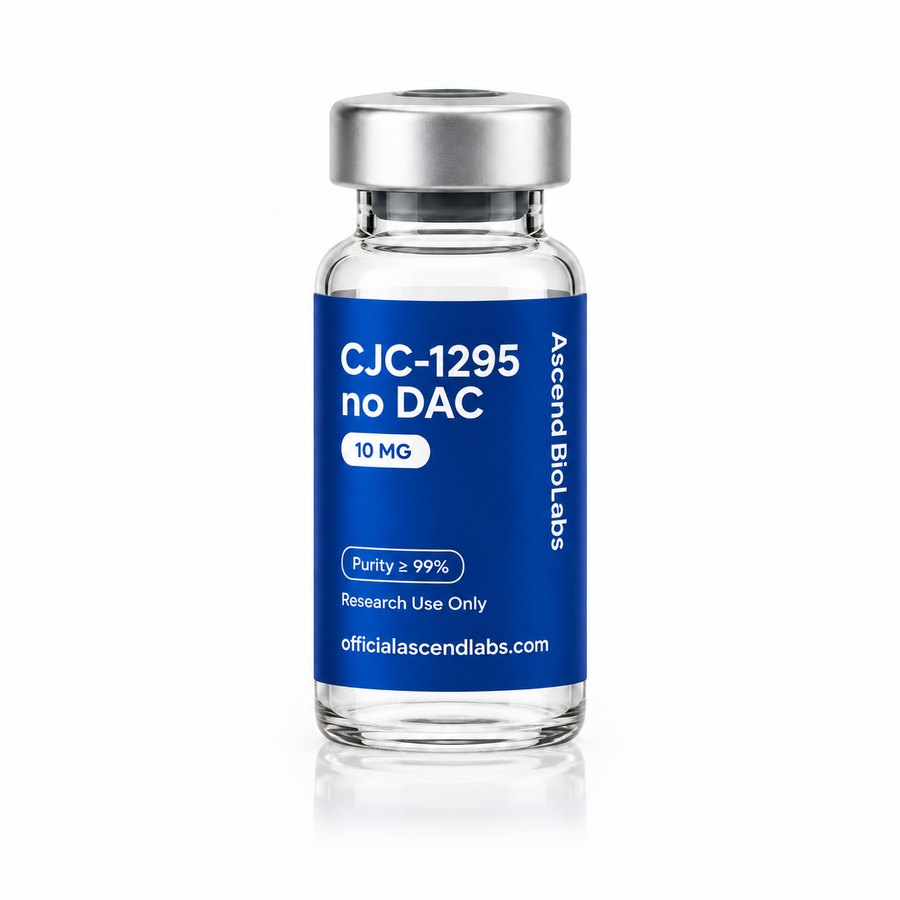
CJC-1295 no DAC
CJC no DAC is a stabilized 29-amino acid GHRH analog studied for its roles in pituitary somatotroph receptor binding, cAMP signaling cascades, and pulsatile growth hormone secretion. A widely characterized compound in endocrine and growth hormone-IGF-1 axis research literature.
 COA RESEARCH USE ONLY
GLP-TRZ
GLP-TRZ is a 39-amino acid dual GIP/GLP-1 receptor agonist peptide studied for its roles in incretin signaling, pancreatic beta-cell insulin secretion, and central appetite regulation pathways. A widely characterized compound in metabolic and endocrinology research literature.
 COA RESEARCH USE ONLY
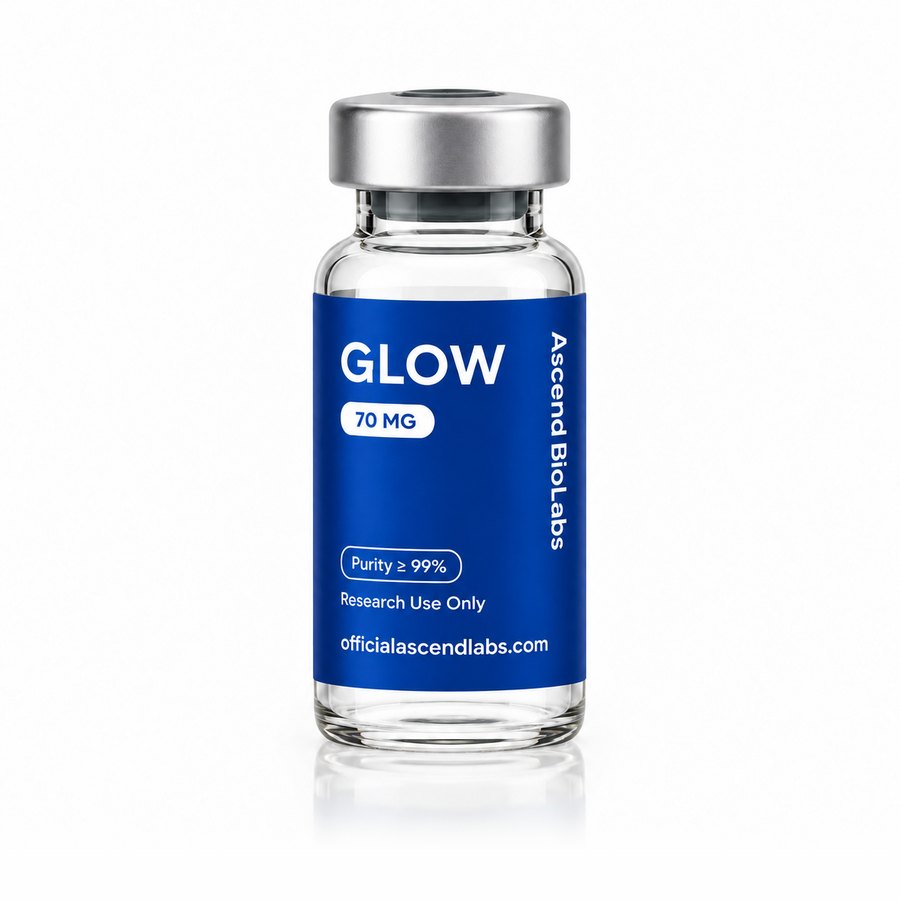
GLOW
GLOW is a multi-peptide blend combining GHK-Cu, BPC-157, and TB-500 studied for its roles in extracellular matrix remodeling, angiogenesis signaling, and cytoskeletal repair pathways. A widely referenced combination in regenerative biology and dermal repair research literature.
More from Ascend BioLabs Education
- What Are Research Peptides? A Laboratory Primer
- How to Read a Peptide Certificate of Analysis
- Peptide Storage and Handling for Laboratory Use
- Verifying a Research Peptide Supplier and Research-Use-Only Limits
- Tissue Repair Peptide Research: BPC-157, TB-500 and GHK-Cu
- Growth Hormone Secretagogue Research: CJC-1295, Ipamorelin and Tesamorelin
- GLP-1 Class Peptide Research: Retatrutide and Tirzepatide
- Reconstitution and Laboratory Technique for Lyophilized Peptides
- Mitochondrial and Longevity Peptide Research: NAD+, MOTS-c, SS-31 and Epithalon